BSAS Conference 2025
The British Society of Animal Science (BSAS) Annual Conference 2025 was held from April 8–10 at the Galway Bay Hotel in Salthill, Galway, Ireland. The event brought together researchers, industry professionals, and policymakers to discuss the theme: “Supporting Livestock’s Role in a Global Society.”
Dr. Ed Smith, Data & Technical Services Manager at the Texel Society, addressed the reported cases of Microphthalmia in 2023 within the ‘Sustainable Sheep – New Approaches and Technologies’ session.
He highlighted the swift action taken by the Society to investigate the issue using our comprehensive genomic database, enabling a rapid understanding of the condition in the breed.
Dr. Smith also introduced the Society’s latest tools and services, designed to support members in identifying the genetic status of their animals and making informed breeding decisions. These innovations mark a significant step forward in promoting animal health and genetic progress within the breed.
The Society’s additional work on introducing genomic evaluations was further recognised with a poster presentation, selected for inclusion in ‘Poster Round 2’.
Adopting genomic technologies to provide insights on Microphthalmia in Texel sheep
Ed Smith & John Yates
In 2023, anecdotal reports of Microphthalmia—a genetic eye disorder causing blindness and early mortality in lambs—prompted swift action by the Texel Sheep Society. Using an existing genomic database, the Society identified animals carrying the gene linked to the condition and provided this information to breeders, along with breeding guidance to help reduce the risk of producing affected lambs.
Microphthalmia is a recessive inherited condition associated with a specific mutation in the PITX3 gene. Through retrospective analysis of over 7,900 genotypes, including 5,795 registered males, the Society found an overall 2.2% carrier rate among pedigree sires, with an increase noted in recent birth years. This rise was linked to the widespread use of a few influential carrier sires.
To address the issue, the Society has implemented routine genotype reporting and made data publicly available through its online database. This empowers breeders to make informed, responsible decisions, improving animal welfare and reducing preventable lamb losses due to blindness.
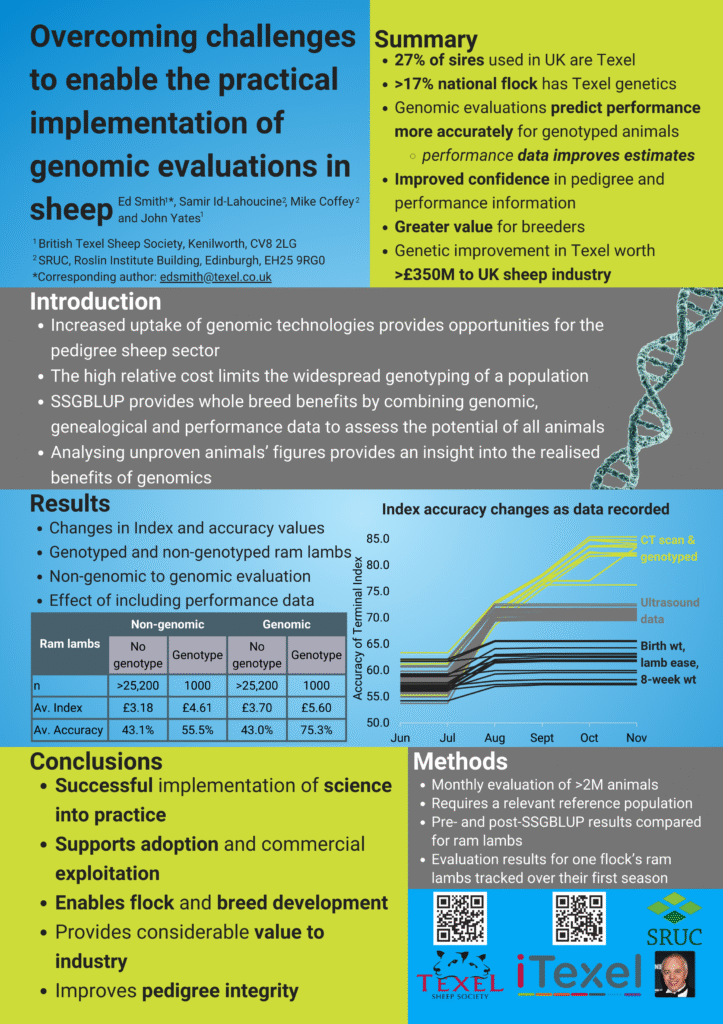
Overcoming challenges to enable the practical implementation of genomic evaluations in sheep
Ed Smith, Samir Id-Lahoucine, Mike Coffey and John Yates
The Texel breed is the UK’s leading terminal sire and a key contributor to the national maternal flock. To support faster and more accurate genetic improvement, the Texel Sheep Society has implemented genomic evaluations using the Single-Step Genomic Best Linear Unbiased Prediction (SSGBLUP) method. This approach integrates DNA data with pedigree information to provide more accurate predictions of an animal’s genetic potential—benefiting both genotyped and non-genotyped animals.
Over 19,000 animals were genotyped and evaluated across multiple commercially important traits. Results showed significant improvements in prediction accuracy—particularly for traits like intramuscular fat and scan weight—compared to traditional pedigree-only evaluations. Genotyping also enabled parentage verification, improving data quality and flock book integrity.
While the cost of genotyping remains a barrier to widespread use, the benefits are substantial. Genomic data allows breeders to make earlier and more informed decisions, especially for young animals, supporting genetic gain and delivering greater value to the commercial market.
The Texel Society’s investment in genomic tools demonstrates a commitment to innovation and provides a model for modern sheep breeding.